How To Filter Out Synthetic Influencers On Social Media Feeds?
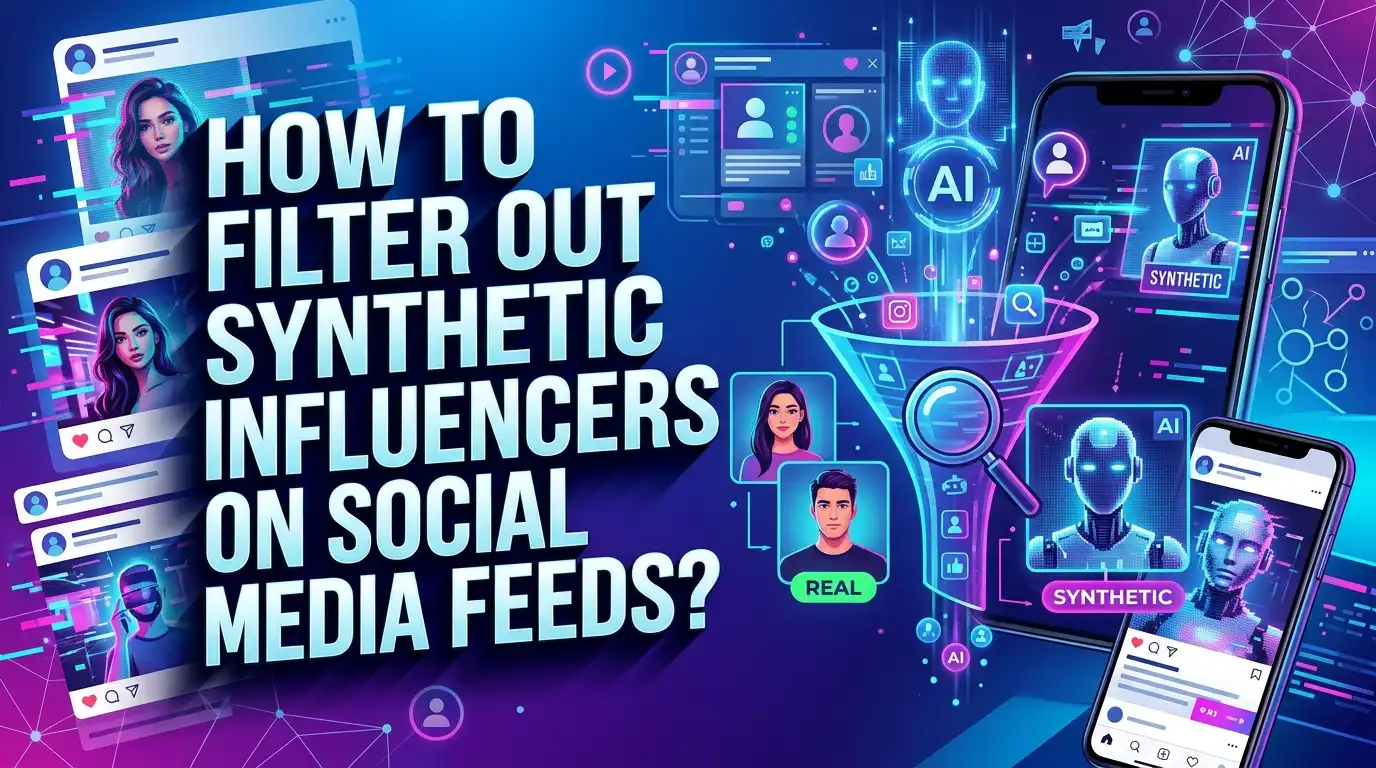
Your social media feed is full of faces that look real but do not exist. Synthetic influencers, also called virtual influencers or AI generated influencers, are digital personas built with artificial intelligence and computer graphics. They post photos, share stories, recommend products, and gather millions of followers.
Here is the problem: most people cannot tell the difference between a synthetic influencer and a real person. That means your feed may be shaped by content from personas that have no real experiences, no genuine opinions, and no authentic connection to the products they promote.
Fake or bot followers account for 56.5% of all reported fraud or quality issues in influencer programs. If you care about consuming honest content and making informed decisions, you need to learn how to spot and filter out these digital imposters.
This guide gives you clear, practical steps to reclaim your social media feed and protect yourself from synthetic influence.
Key Takeaways
- Synthetic influencers are AI created digital personas that mimic real people on social media. They can post daily, never age, and never go off brand. The market for these virtual personas is expected to grow at a 41.29% CAGR through 2032.
- Engagement patterns reveal the truth. Virtual influencer campaigns average a 5.67% engagement rate, but the comments and interactions often lack genuine human connection. Look for generic, repetitive comments and emoji only responses as red flags.
- Free and paid tools can help you verify accounts. Fraud detection tools can identify fake followers with 92% to 94% accuracy. Use these tools before you trust any influencer’s recommendations.
- Platform labels and disclosure rules are expanding. The FTC banned undisclosed AI generated endorsements in October 2024, and Meta began labeling AI generated content. Check for these labels on every post you see.
- Your feed settings give you control. Most platforms let you mark content as “not interested,” mute accounts, and adjust algorithmic preferences. Use these features regularly to train your feed away from synthetic content.
- Critical thinking is your best filter. No tool replaces your own judgment. Question perfection, check for real world presence, and verify claims before acting on any influencer’s recommendation.
What Are Synthetic Influencers And Why Should You Care
Synthetic influencers are digital characters created using artificial intelligence, 3D modeling, and computer graphics. They exist only as code and pixels. A team of developers, marketers, and artists controls every aspect of their appearance, personality, and content. Some of the most famous examples include Lil Miquela, who has earned approximately $11 million in career brand deal revenue, and Lu do Magalu, who earned $2.5 million in 2024 across 74 sponsored posts.
These virtual personas look incredibly realistic. Modern AI tools can generate faces, expressions, and body language that fool most viewers. About 35% of Gen Z consumers report buying products promoted by a virtual personality. That means real money flows based on recommendations from entities that have never used, touched, or experienced the products they promote.
You should care because synthetic influencers shape purchasing decisions, beauty standards, and cultural trends without any lived experience behind their content. They do not eat the food they recommend. They do not wear the clothes they model. They do not use the skincare products they endorse. Every word and image comes from a marketing team with specific sales goals. Understanding this distinction helps you make better choices about what content you trust and what products you buy.
How The Synthetic Influencer Industry Has Grown So Fast
The growth of synthetic influencers has been explosive. The virtual influencer market was valued at $6.06 billion in 2024 and reached $11.74 billion in 2026. Forecasts place it at $154.6 billion by 2032. Several factors drive this rapid expansion.
First, production costs have dropped dramatically. AI tools that generate realistic human faces and bodies now cost less than $50 per campaign. A brand can create a virtual influencer for a fraction of what it costs to hire a human creator for a year. Once the digital avatar pipeline is built, the marginal cost per piece of content trends close to zero.
Second, brands love the control factor. A synthetic influencer never has a scandal. They never show up late to a shoot. They never demand higher rates mid contract. About 73% of surveyed companies globally now use virtual influencers, up from 60% just a year earlier. Beauty and personal care brands lead at 89% adoption.
Third, the technology keeps improving. AI generated faces have become so convincing that researchers warn these personas are increasingly difficult to detect. The gap between real and fake shrinks every month, which makes your ability to identify synthetic content more important than ever.
Check For AI Content Labels On Social Media Platforms
The easiest first step is to look for AI content labels that platforms now add to posts. Meta began labeling AI generated content in 2024. Instagram, Facebook, and Threads apply “AI Generated” or “Made with AI” tags to content that triggers their detection systems. TikTok has similar labeling features.
These labels appear near the username or at the bottom of a post. They are small and easy to miss if you scroll quickly. Slow down and look for these markers before you engage with any influencer content. A labeled post tells you immediately that some or all of the content was created with AI tools.
However, labels are not perfect. Platforms rely on metadata and detection algorithms that miss some AI content. The FTC’s final rule banning undisclosed AI generated endorsements took effect on October 21, 2024, with penalties reaching $51,744 per violation. This means creators and brands face legal consequences for hiding AI involvement. But enforcement takes time, and many synthetic accounts slip through.
Make label checking a habit. Every time you see a post from an account you do not recognize, look for the AI disclosure tag. If the platform has flagged it, take that information seriously before you trust anything in the post.
Examine The Influencer’s Engagement Patterns Closely
Engagement patterns are one of the most reliable signals for identifying synthetic influencers. Genuine human influencers have messy, varied engagement. Their comment sections include long conversations, personal stories, disagreements, and questions. Synthetic influencer accounts often show a different pattern.
Look at the comments on any suspicious account. If you see mostly emoji only responses, one word compliments like “amazing” or “beautiful,” and generic praise that could apply to any post, that is a warning sign. Bot followers and purchased engagement produce this exact pattern. Real audiences leave specific comments that reference the actual content of a post.
Check whether the same small group of accounts comments on every post. This pattern suggests engagement pods, where groups of accounts agree to interact with each other’s content to boost visibility. About 56.5% of all reported fraud or quality issues in influencer programs involve fake or bot followers.
Also look at the ratio between followers and engagement. An account with 500,000 followers but only 200 likes per post has a suspiciously low engagement rate. On the other hand, an account with 10,000 followers and 5,000 likes per post may have purchased engagement. Industry benchmarks show that accounts with 2,000 to 5,000 followers average about 6% engagement, while accounts over 1 million followers average about 1.5%.
Use Free Tools To Audit Influencer Authenticity
Several free and paid tools can help you verify whether an influencer account is genuine. HypeAuditor provides an authenticity score and fake follower percentage for Instagram accounts. It analyzes follower profiles, engagement quality, and audience demographics to give you a quick pass or fail assessment.
Other tools include Modash, which offers a credibility score, and Collabstr’s free Instagram fake follower checker. These tools examine metrics like comment quality, follower growth patterns, and audience geography. AI fraud detection systems now correctly identify fake engagement 92% to 94% of the time, which makes them a valuable resource for any social media user.
You do not need to be a brand manager to use these tools. If an influencer’s recommendation is about to influence a purchase decision, spend two minutes running their username through a free checker. The results will show you what percentage of their followers appear to be real accounts versus bots or inactive profiles.
Look for accounts where the real follower estimate falls below 60%. Any account with more fake followers than real ones should be treated with extreme skepticism. Even accounts in the middle range deserve extra scrutiny before you trust their content or product recommendations.
Look For Physical Inconsistencies In Photos And Videos
AI generated images have improved dramatically, but they still leave visual clues. Pay close attention to hands, fingers, and accessories in photos. AI often struggles with these details, producing extra fingers, oddly bent joints, or jewelry that merges with skin.
Check the background of photos carefully. AI generated images sometimes contain blurred text, warped architecture, or objects that do not quite make sense. A door handle might be at the wrong height. A reflection might not match the subject. Trees or buildings might have impossible geometry.
Hair is another tell. AI generated hair can look too perfect or show strange merging patterns where strands meet the face or shoulders. Teeth can also appear too uniform or oddly shaped in AI generated faces. Ears sometimes differ noticeably between photos of the same “person.”
For video content, watch for unnatural facial movements, lip sync issues, and odd blinking patterns. AI generated video has improved, but subtle timing differences in expressions still exist. If something feels slightly off about a video but you cannot pinpoint why, your instincts may be detecting the uncanny valley effect that synthetic content produces. Trust that feeling and investigate further.
Investigate The Influencer’s Real World Presence
A genuine influencer exists outside of social media. They attend events. They appear in other people’s photos and videos. They have a history that you can trace through multiple independent sources. Synthetic influencers exist only in their own content.
Search for the influencer’s name outside of social media. Look for news articles, interviews, podcast appearances, or event coverage. A real person will have a digital footprint that extends beyond perfectly curated Instagram posts. Check whether other real, verified accounts tag them in candid photos or mention them in genuine conversations.
Look at their posting history. Real influencers have content that evolves over time. Their early posts might be lower quality. Their style changes as they grow. Synthetic influencers often launch with a polished, consistent aesthetic from day one. There is no learning curve, no awkward early content, no growth arc.
Check LinkedIn, personal websites, and professional directories. If someone claims to be a fitness expert, nutrition coach, or beauty professional, there should be credentials, business registrations, or professional affiliations that you can verify independently. The complete absence of any verifiable real world presence is a strong indicator that you are looking at a synthetic persona.
Adjust Your Feed Algorithm To Reduce Synthetic Content
Every major social media platform gives you tools to control what appears in your feed. Use the “Not Interested” button aggressively. On Instagram, tap the three dots on any post and select “Not Interested.” On TikTok, long press a video and choose the same option. This trains the algorithm to show you less similar content.
Mute or block accounts that you suspect are synthetic. This sends a strong signal to the algorithm about your preferences. The more synthetic accounts you remove, the better your feed becomes at showing you genuine human content.
Follow verified, established creators whose real world identities you can confirm. The algorithm prioritizes content from accounts you actively engage with. By consistently interacting with genuine creators and ignoring or dismissing synthetic ones, you reshape your feed over time.
Consider switching from algorithmic feeds to chronological feeds where available. Twitter/X, Instagram, and Facebook all offer chronological or “Following” feed options. Chronological feeds show you content only from accounts you chose to follow, which eliminates the algorithm’s tendency to inject trending synthetic content into your experience. Check your platform settings and make this switch today.
Watch For Perfection As A Warning Sign
Real life is imperfect. Real influencers have bad lighting days, awkward angles, and unpolished moments. Synthetic influencers are suspiciously perfect. Every photo has flawless skin, ideal lighting, and precise composition. There are no candid moments, no behind the scenes messiness, and no raw, unfiltered content.
If an account’s entire feed looks like it came from a professional studio with zero variation in quality, that is a red flag. Human creators have range in their content quality. Some posts are more polished than others. Some are taken quickly on a phone. Some are collaborative and spontaneous.
Watch for perfectly consistent skin texture across all photos. Real skin has pores, freckles, scars, and variations that change with lighting and camera quality. AI generated skin often has a smooth, airbrushed quality that stays identical from post to post. This uniformity is difficult for even the best AI to avoid completely.
Also notice whether the person’s body proportions remain exactly the same in every image. Real bodies shift slightly based on posture, clothing, and camera angle. AI generated bodies can show impossible consistency or subtle proportion errors that your eye might catch even if your conscious mind does not immediately register them.
Verify Product Claims And Recommendations Independently
Even if you cannot determine with certainty whether an influencer is synthetic, you can still protect yourself from misleading recommendations. Never buy a product based on a single influencer’s recommendation. Search for independent reviews from verified purchasers on retail sites, consumer forums, and review platforms.
Check whether the product claims match what you find in independent testing. Organizations like Consumer Reports, dermatologist reviews, and registered dietitian assessments provide evidence based evaluations that no influencer can match. Use these sources as your primary decision making tools.
Look for the disclosure tags on sponsored content. The FTC requires influencers to clearly mark paid partnerships with labels like #ad, #sponsored, or the platform’s built in paid partnership tag. About 2,340 individual creators have been formally investigated across the FTC and UK FCA in 2026 for failing to properly disclose paid content.
If a recommendation seems too good to be true, it probably is. Synthetic influencers are designed by marketing teams to sell products. Every word they “say” is crafted to drive a purchase. By verifying claims independently, you remove the synthetic influencer’s power over your buying decisions, regardless of whether they are human or AI.
Educate Yourself About Common AI Generation Tells
Staying informed about AI technology helps you stay ahead of synthetic content. AI generated content changes fast, but certain patterns persist. Text in AI generated images is often garbled or nonsensical. Backgrounds may contain objects that blend into each other. Symmetry in faces can be slightly too perfect.
Follow accounts and publications that track AI detection methods. Researchers regularly publish new findings about how to identify AI generated media. AI literacy is becoming an essential skill for anyone who uses social media regularly. About 75% of Gen Z consumers actively engage with virtual influencer content, which means the youngest generation needs these skills most urgently.
Learn about deepfake detection signals in video content. These include inconsistent skin tones between frames, audio that does not match lip movements precisely, and lighting that shifts unnaturally. Deepfake enabled influencer fraud caused an estimated $23.7 billion in global losses in 2026 across all use cases.
Practice by testing yourself with known examples. Several websites publish collections of AI generated faces alongside real photographs. The more you train your eye, the faster you will spot synthetic content in your daily scrolling. This skill improves with practice, and even a few minutes of training can dramatically sharpen your ability to identify fake personas.
Build A Trusted Circle Of Verified Human Creators
One of the best long term strategies is to curate a small group of verified human influencers whose identities you have confirmed. Follow creators who show their real lives, including the messy parts. Engage with accounts that have verifiable histories, documented credentials, and genuine community interactions.
Look for influencers who have been active for years and whose content shows real personal growth and change. Long track records are difficult for synthetic influencers to fake. A creator who has posted consistently since 2015 with gradually improving content quality is almost certainly a real person.
Prioritize micro influencers in your niche. These are creators with 1,000 to 50,000 followers who tend to have higher authenticity rates and deeper connections with their audiences. The beauty niche alone has a fake follower rate of 52.1%, but smaller accounts within that niche are more likely to be genuine.
Engage meaningfully with the creators you trust. Leave thoughtful comments. Share their content. Build a real connection. When you invest your attention in a smaller number of verified human creators, your feed naturally fills with genuine content and pushes synthetic accounts to the margins. Quality of connection matters more than quantity of follows.
Report Suspicious Accounts To Help Clean Up The Platform
Every report you file contributes to a cleaner social media environment. All major platforms have reporting features for fake accounts, misleading content, and undisclosed AI generated material. Use these tools whenever you identify a suspicious account.
On Instagram, tap the three dots on the profile page and select “Report.” Choose the option that best describes the issue, such as “fake account” or “misleading content.” On TikTok, use the share button and select “Report.” Each report feeds into the platform’s detection algorithms and helps train them to catch similar accounts automatically.
Reporting is especially important for accounts that target vulnerable audiences. Synthetic influencers promoting health products, financial advice, or beauty standards to young users can cause real harm. About 43.8% of consumers report significant ethical concerns about AI influencer use, and your reports help platforms address those concerns.
Encourage others to report as well. Share what you have learned about identifying synthetic influencers with friends and family. The more users who actively report fake accounts, the harder it becomes for synthetic influencer operators to maintain their presence. Collective action makes platforms safer for everyone.
What To Do If You Have Already Been Influenced By A Synthetic Account
If you realize you have been following and trusting a synthetic influencer, do not feel embarrassed. These accounts are designed by professional marketing teams to be convincing. Even experienced digital marketers get fooled. The technology improves every month, and detection is genuinely difficult.
Start by reviewing any purchases you made based on that account’s recommendations. If products were misrepresented, you may be eligible for refunds under consumer protection laws. Document the posts that influenced your purchase and contact the retailer’s customer service team.
Unfollow the account immediately and mark it as “Not Interested.” Then audit the rest of your following list. If one synthetic account fooled you, others might have as well. Spend 30 minutes reviewing the accounts you follow and apply the detection techniques from this guide to each one.
Use this experience as motivation to build stronger media literacy habits. Set a monthly reminder to audit your following list. Check new accounts against verification tools before you follow them. Share your experience with others so they can avoid the same trap. Every person who learns to filter synthetic content makes the entire social media ecosystem more honest.
Frequently Asked Questions
What is a synthetic influencer?
A synthetic influencer is a digital persona created using AI, 3D modeling, and computer graphics. These virtual characters post content, promote products, and build followings on social media platforms. They are controlled entirely by human teams or automated systems. They do not exist as real people and have no genuine personal experiences with the products or lifestyles they promote.
How can I tell if an influencer is AI generated?
Look for visual clues like perfect skin in every photo, inconsistent hand details, and garbled background text. Check their engagement patterns for generic comments and bot activity. Search for their real world presence outside social media. Use free tools like HypeAuditor or Collabstr to audit their follower authenticity. Also check for AI content labels that platforms now apply to detected synthetic content.
Are synthetic influencers legal?
Synthetic influencers are legal, but regulations are tightening. The FTC’s October 2024 rule bans undisclosed AI generated endorsements and fake reviews. Penalties can reach $51,744 per violation. The EU AI Act and UK FCA also impose disclosure requirements. Brands and creators must clearly label AI generated content and paid partnerships to stay compliant.
Why do platforms allow synthetic influencers?
Platforms allow synthetic influencers because they generate engagement, attract advertisers, and drive revenue. Virtual influencer campaigns average 5.67% engagement rates, which is roughly three times higher than human creator campaigns. Platforms benefit financially from this high engagement. However, increasing regulation and user demand for transparency are pushing platforms to implement better labeling and detection systems.
Can fake follower detection tools really work?
Yes. AI powered fraud detection systems correctly identify fake engagement 92% to 94% of the time according to industry benchmarks. Tools like HypeAuditor, Modash, and Collabstr analyze follower profiles, engagement quality, and growth patterns to provide authenticity scores. While no tool is 100% accurate, they significantly improve your ability to distinguish genuine accounts from synthetic or fraudulent ones.
How do I protect my children from synthetic influencer content?
Start by having open conversations about AI generated content and how it differs from real human creators. Enable parental controls on social media platforms. Teach children to look for AI content labels and to question overly perfect imagery. Follow accounts together and discuss what seems real versus manufactured. Building AI literacy early gives young users the critical thinking skills they need to identify synthetic content independently.